

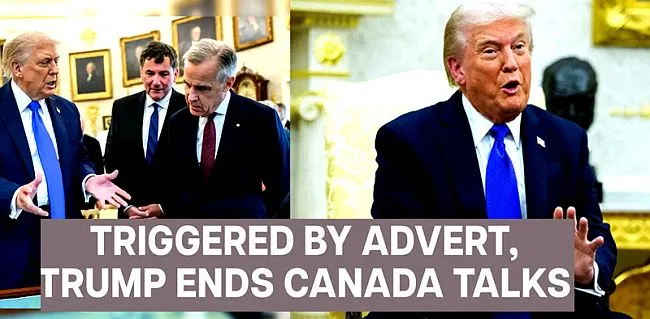
On Saturday Canadian Prime Minister Justin Trudeau disclosed that he’d personally
tendered an apology to President Donald Trump regarding an advertisement that castigated U.S. Tariffs and he also affirmed that he’d instructed Ontario Premier Doug Ford to discontinue the campaign.
After the Asia‑Pacific Economic Cooperation (APEC) summit, in South Korea the Prime Minister told reporters the following.
A Private Apology Whispered at the Leaders Dinner
When outlining the exchange Trudeau said the apology was quietly offered to President Trump during a Wednesday dinner hosted by the Korean president with both leaders attending the international forum.
The incident throws a spotlight on the diplomatic maneuvers required to keep the Canada‑U.S. Trade relationship on an even keel while also preempting any friction that might erupt from domestic political messaging.
Prime Minister Justin Trudeau openly affirmed that he had apologized to U.S. President Donald Trump over an ad commissioned by Ontario Premier Doug Ford that lambasted America’s tariff policy. The admission comes after President Trump first alluded to the apology on Friday.
Trudeau addressing the incident head‑on said, “I did apologise to the president.”
Trudeau claims he was opposed to the advertisement.
In a disclosure Prime Minister Trudeau admitted that he’d examined the ad together with Premier Ford before it was broadcast and even though he’d seen it in advance he insists he warned them outright against its use.
The Prime Minister said, “I told Ford I didn’t want to push with the ad ” distancing his government from the provincial political campaign.
Advertising. The United States’ Retaliatory Response
The ad, funded by the Premier Doug Ford—often compared to Trump—features a short clip of Republican icon former President Ronald Reagan. In that excerpt Reagan warns that tariffs ignite trade wars and inevitably lead to disaster.
The ad sparked a reaction, from the Trump administration. In its aftermath President Trump announced tariffs on goods and effectively put an end to any trade talks, between the two nations.
Diplomatic. A Very Nice” Conversation
With the public sparring on display the diplomatic machinery kept turning. As Trump boarded his flight out of South Korea this week he remarked that his tête‑à‑tête, with Trudeau, at the leaders dinner was “very nice ” though he chose not to elaborate.
Readmore Exclusive: Indian Refiners Halt New Russian Oil Purchases Amid Payment
Friday found the U.S. President holding fast declaring that trade talks, between the United States and Canada would not be revived even as he recognized that Prime Minister Trudeau had apologized for the Ontario advertisement starring Ronald Reagan.
Canada’s prime minister, Justin Trudeau says he personally apologized to President
Donald Trump after a political ad commissioned by Ontario Premier Doug Ford took aim at U.S. Tariff policy. Trudeau added that he told Ford outright not to run the ad.
After returning from the Asia‑Pacific Economic Cooperation (APEC) summit, in South Korea the Prime Minister addressed reporters on Saturday issuing these statements.
A hushed private apology, over dinner, in Seoul.
Trudeau revealed that the diplomatic apology, delivered in private was made during a Wednesday dinner hosted by the president, where both leaders were present.
“I did apologise, to the president ” Trudeau said, thereby confirming the remarks President Trump had made the Friday.
Trudeau was, against the ad, from the start.
During an interview Prime Minister Trudeau said he’d already seen the ad before it aired after reviewing it together with Premier Ford. He added, however that he’s been opposed to its use, from the beginning.
“I told Ford I have no appetite, for pushing that ad ” he said, making it unmistakably clear that the government’s stance was being set apart, from the provincial campaign.
The appearance of a Reagan clip, in a commercial set off a tariff response, from the United States.
The advertisement, underwritten by the Premier Doug Ford—frequently likened to Trump—incorporated a throw‑back clip of the late Republican President Ronald Reagan. In that segment Reagan’s voice is used to assert that “tariffs cause trade wars and economic disaster.”
The advertisement ignited an instantaneous far‑reaching backlash, out of Washington. In its aftermath President Trump proclaimed tariffs on merchandise and officially put an end to every trade negotiation still in motion, with Canada.
Holding a position even though the exchange turned out to be unexpectedly cordial.
The episode throws a spotlight on the state of trade relations, between Canada and the United States. Trump while bragging that his dinner exchange with Trudeau, in Seoul was “very nice ” stuck to his hard‑line trade stance. Come Friday he again made clear that the two nations would not pick up trade talks even as he acknowledged Trudeau’s apology.
In 1936 John Scott—son of the Guardian editor C. P. Scott—made a decision, for a media heir. He voluntarily relinquished his stake in the newspaper placing the good, above personal interest.
Readmore Picking Under Fire: How Settler Violence is Strangling a Palestinian Tradition
Having come into possession of the newspaper .
Scott disavowed any profit—retaining his remuneration—and conveyed the title of The Guardian (then worth £1 million, roughly £62 million today), to the newly instituted Scott Trust.
A ceaseless drive, toward independence
That act set the foundation, for the Trusts enduring mission: to keep the Guardian financially and editorially independent forever.
The upshot of that bedrock principle is clear: The Guardian simply cannot be sold. It stands insulated against purchase by private‑equity firms, sprawling conglomerates or a billionaire looking to use it as a mouthpiece.
What This Independence Actually Looks Like When Put Into Practice
Our one‑of‑a‑kind ownership structure gives us a freedom meaning we’re empowered to:
A report, on stories delivered without dread or partiality.Put authority under the microscope. Insist the answer, for their deeds.When the stakes are highest we stand up for our values.
The model is sustained by the engagement of our readers.Because a trust, than shareholders owns us we rely on the support of readers Pakistan included—to fund our journalism.
If you’re of the mind that the news you digest ought to be molded by journalists and editors—not corporate shareholders or a cadre of ultra‑rich owners— consider hopping on board with us in this mission.
