

The Toss Heard, The Hands Unheld: The Silent Drama at the U19 World Cup Toss In the largely orchestrated, media- impregnated world of ultramodern.
Justice certain rituals are performed with rehearsed, unthinking familiarity. Thepre-match toss is one similar ritual a detail, televised moment of fair contact where two captains shake hands, exchange amenities, and let fate decide who batons or coliseums first.
It’s a symbol of respect and the spirit of the game. Yet, in the 2024 ICC Under- 19 World Cup in South Africa, this mundane ritual came a oil painting for a profound and silent geopolitical drama.
The moment between the captains of India and Pakistan .
Uday Saharan and Saad Baig was not defined by a handshake, but by its conspicuous, deliberate absence. This was the toss heard, the hands unheld — a transitory, wordless commerce that reverberated with the weight of decades of complex history, speaking volumes in its eloquent silence.
On the face, the match progressed typically.
India won the toss, chose to club, and secured a hard- fought palm. The action on the pitch was spectacular. But for millions watching, the story had formerly been written in the 15 seconds before a coin was spun.
The turndown to shake hands was n’t an impulsive act of teenage irascibility; it was a scripted moment of political theater, revealing how deeply the pressures between the two nations have strained into indeed the most inferior situations of the sport meant to unite them.
The deconstruction of a Snub A Ritual intruded
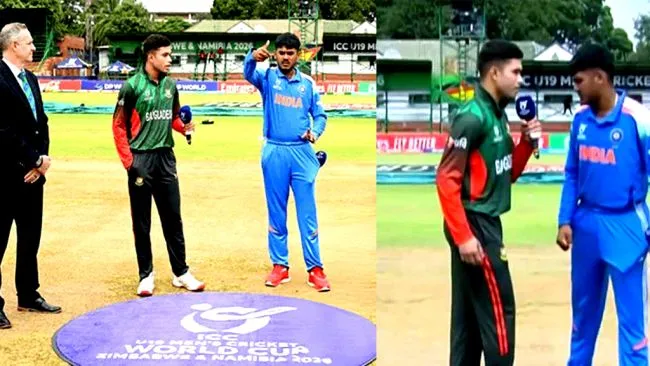
The visual was stark and unequivocal. As the two youthful captains, slightly out of their teens, met at the center of the pitch with the match adjudicator, the usual protocol unraveled. There was no extended hand from the Pakistani captain, Saad Baig.
The Indian captain, Uday Saharan, after a moment of apparent vacillation and an awkward half- gesture, kept his hands forcefully by his side. A brief, tense nod was changed. The coin was tossed.
The moment passed, but its echo filled the colosseum and resounded across social media and news channels.
This was a divagation so stark it could n’t be accidental. In the high- pressure, strictly managed terrain of an ICC global event, every action, especially by captains, is considered. The handshake is as much a part of thepre-match roster as the platoon wastes. Its elision was a deliberate signal, anon-verbal statement loaded with meaning.
Environment is King The Weight of History on Young Shoulders
To dismiss this as bare rudeness is to ignore the immense literal and political baggage these youthful men carry, frequently inevitably. India and Pakistan’s cricketing relations live in a state of perpetual, fragile suspense. Since the 2008 Mumbai attacks, bilateral series have been nearly defunct.
They meet only in ICC or ACC( Asian Cricket Council) events. Every hassle is magnified into a”mini-war,” a deputy battleground where public pride is at stake.
The players, especially at the elderly position,
Operate under immense, frequently intolerable pressure. triumphs are celebrated as public triumphs; losses can lead to vicious abuse and indeed pitfalls.
Readmore A Cold Stand in Cricket’s Heartland: How Bangladesh’s Boycott Could Redraw the World Cup Map
This poisonous atmosphere has sluggishly trickled down. The Under- 19 position, once a fairly pure space for expiring gift, is now a exemplification of the elderly dynamic. These teenagers are n’t just playing for themselves; they’re shouldering the prospects of a billion people and navigating a relationship fractured by terrorism,
Territorial controversies, and deep- seated enmity.
The directive to avoid the handshake probably did n’t appear with the 18- time-old captains. It nearly clearly came from advanced authorities — platoon operation or board officers instructing the players to make a emblematic political stage. The youthful captains came pawns in a larger game, their particular instincts maybe hoofed by public accreditation.
The Communication in the Silence What the Snub Communicated
The unheld handshake was amulti-layered communication
A Rejection of” Normalization” It rejected the ICC’s attempt to frame the match as a” normal” sporting contest between two member nations. It claimed on admitting the abnormal, simulated political reality.
A Gesture of Solidarity with a National Posture For Pakistan,
It echoed the state’s longstanding grievance that India refuses to engage in bilateral justice. It turned the tables, using the global stage to show Pakistan’s own turndown to engage in indeed the most introductory civility, framing India as the hermit.
An Internal Signal For domestic cult in both countries, the rebuff was a performance of durability and public resoluteness. It showed that indeed the youthful ministers would not offer” gratuitous” courtesy to thearch-rival, a station that plays well to strict nationalist constituencies back home.
The Politicization of the Young Most tragically,
it verified the complete politicization of the youth game. It demonstrated that there’s no longer any sanctuary, not indeed at the Under- 19 World Cup, Hands where sport can be temporarily separated from statecraft.
The response Outrage, defense, and sick Abdication
The global justice community replied with a blend of disappointment and commination. Former players and pundits lamented the loss of spirit. The ICC, guardians of the game’s” spirit,” set up itself in a bind, likely issuing private comminations but helpless to apply sportsmanship that is, technically, a convention, not a codified law.
In India and Pakistan.
Responses resolve along predictable lines. jingoists on both sides praised the” strong” station. Centrists and true justice suckers expressed deep sadness. numerous felt a sense of sick abdication this was just the rearmost, ineluctable chapter in a long, saddening story.
